AECOM calls for ‘responsible progress’ ahead of World Environment Day 2026

The call comes at a time where cities across the Middle East continue to evolve with nation-shaping infrastructure projects

AECOM’s Middle East leadership team is calling for the region’s next generation of infrastructure to balance scale and speed with environmental stewardship, resilience and long-term social value. The call comes in alignment with World Environment Day 2026 – one of the UN’s flagship initiatives to encourage worldwide awareness and collective action to protect the planet.
The call comes at a time where cities across the Middle East continue to evolve with nation-shaping infrastructure projects that are redefining skylines, coastlines and communities.
While governments pursue ambitious economic diversification strategies and transformative urban growth, the pressure to ensure these developments remain environmentally responsible and socially resilient has never been greater, AECOM highlights.
This challenge sits at the heart of what the company describes as ‘responsible progress’ where stakeholders deliver complex, high-performance infrastructure that creates long-term value, while reducing environmental impact and strengthening community wellbeing.
Craig Thackray, Vice President, Environment, AECOM Middle East & Africa notes the conversation around sustainable infrastructure in the region has evolved significantly over the last decade.
He says, “When I started working in sustainability in this region, the conversation was largely about compliance. Today, clients are asking entirely different questions: will this infrastructure perform in 2050? Will it align with national Net Zero commitments? Will it deliver measurable environmental and social value across its full lifecycle?”
AECOM says the shift reflects the growing reality of climate pressures across the Middle East and Africa, where rising temperatures, water scarcity, flooding risks and resource constraints are already influencing how infrastructure must be planned, designed and operated.
In this respect, AECOM states that it’s vital to respond to these pressures long before construction even commences. The company says it places strong emphasis on integrating sustainability, resilience and environmental performance at the earliest stages of planning and design.

Namitha Thomas, Senior Engineer: Environment at AECOM explains that the most consequential sustainability decisions are often made before a single building orientation, layout or material specification is finalised.
She explains, “The most powerful sustainability decisions are made before the first line is drawn. Once a layout is fixed or materials are selected, the range of possible environmental outcomes narrows dramatically.”
AECOM also says that its environmental approach is also increasingly focused on resilience and nature-positive design, particularly as Middle Eastern developments confront more extreme climate conditions.
Balancing rapid urban expansion with ecosystem protection requires integrated, multi-disciplinary planning from the outset, according to Dana Maalouf, Engineer: Environment at AECOM.
“Desert habitats, coastal systems and marine biodiversity are not obstacles to development. They are ecological infrastructure that underpins long-term resilience,” she states.
Across projects in Saudi Arabia and the wider Gulf region, AECOM notes that it is integrating environmental baseline mapping, climate risk analysis, water efficiency strategies, biodiversity considerations and nature-based solutions directly into master planning processes. The company also says that nature-based solutions are becoming increasingly important in addressing climate adaptation challenges such as flooding, heat mitigation and water security.
On one recent project, infrastructure was strategically graded to protect critical assets during extreme rainfall events, while landscaped public park areas were designed to safely absorb stormwater runoff, with minimal disruption to surrounding communities, the firm shares.
AECOM also explained that innovation is playing a growing role in reducing environmental impact, and says that it is deploying AI-enabled design optimisation, digital twins, lifecycle carbon modelling and advanced materials analysis to improve infrastructure performance, while minimising resource consumption.

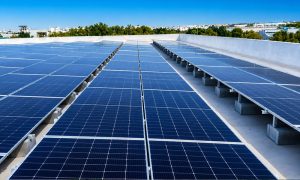
Additionally, the company said it is integrating renewable energy systems, district cooling optimisation, water recycling networks and circular economy principles into major developments across the region.
“Infrastructure today must do more than minimise harm. The goal increasingly is regenerative development, creating cities and communities that actively restore and enhance natural systems rather than simply reducing environmental damage,” Thackray says.
AECOM’s leadership also stresses that accountability must match ambition as governments across the region accelerate large-scale development agendas. The firm stresses that accountability and measurable outcomes are essential to ensuring ambition does not come at the expense of long-term environmental and social stability.
Here, Thomas argues that sustainability commitments must move beyond aspirational messaging and become operational requirements embedded into governance, procurement and delivery frameworks.
She explains, “Ambition without accountability is how you end up with infrastructure that underperforms, ecosystems that are irreversibly damaged and public trust that is difficult to rebuild.”
The firm says it addresses this particular issue through measurable sustainability targets, environmental management systems, ESG risk frameworks and transparent reporting aligned with global standards such as TCFD and SASB. The company notes that it aligns its work with regional and international sustainability frameworks, including LEED, BREEAM, ESTIDAMA, WELL and Envision certification systems, many of which are becoming increasingly mandatory across Middle Eastern infrastructure and development projects.
Partnerships also play a critical role in maintaining accountability across complex, multi-stakeholder projects, the firm outlines.
Thackray adds, “Climate change is a global challenge, and accountability has to be shared across governments, developers, designers, contractors and supply chains. Successful delivery depends on collaboration and collective responsibility.”

Here, AECOM’s Middle East leadership highlights that World Environment Day serves as an important reminder that the built environment sector holds enormous influence over the long-term environmental trajectory of cities and communities.
The decisions made today in planning meetings, procurement processes and design reviews will shape resource consumption, climate resilience and quality of life for generations to come, it adds.
“Ambitious development and environmental responsibility must go hand in hand. Sustainability cannot be treated as a secondary consideration or a communications exercise. It must be embedded into every stage of delivery,” Maalouf stresses.
Thackray agrees and adds that the industry has an opportunity and responsibility to rethink how infrastructure interacts with natural systems and communities.
He concludes, “We should be asking ourselves not only how to reduce harm, but how to create mutual benefit between human development and the natural environment. Every project is an opportunity to improve resilience, restore ecosystems and build a better future.”