Leader of the pack

Wolffkran’s crane safety quest
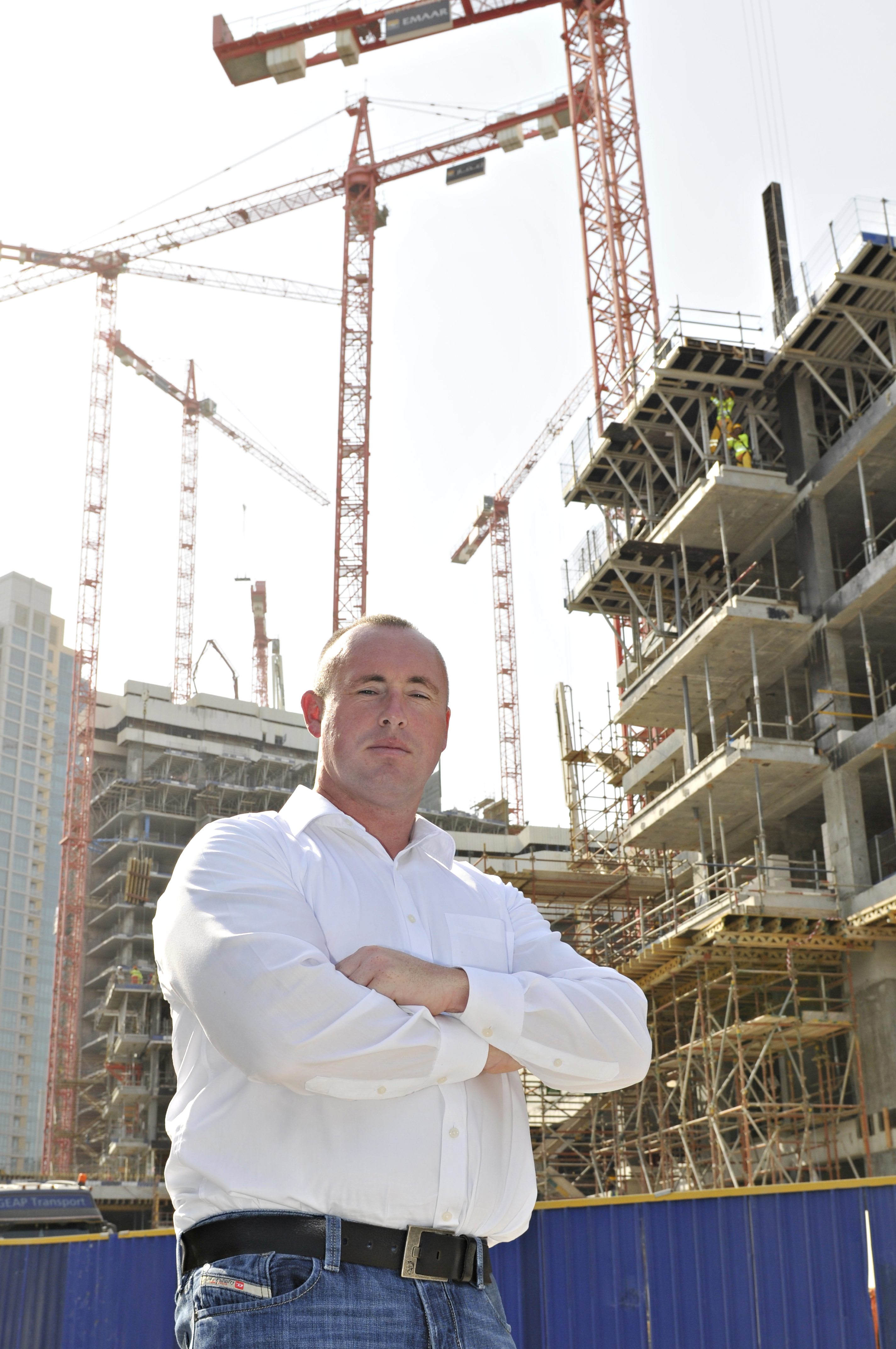
Wolffkran’s operations manager Jeffrey Watson explains why he is leading a personal quest for safety in crane operation in the Middle East
Jeffrey Watson’s day begins at 5.30am when he arrives on site to meet his team of tower crane operators.
Taking time to brief the six-strong team of skilled men he says that the most efficient teams are not those comprising 20, 30 or even 100 personnel, but the ones effectively trained to the highest standards and expertly delegated to their individual tasks.
“It’s just about managing and training your people to do the job they are assigned to do, with confidence and safety,” he adds saying that his personal safety specifications also mean all his team’s work is completed in day light.
Beginning his own career in 1986 – a time when training and licences were non-existent, even on British sites – he says that the practices he has witnessed locally are some of the most hazardous in the world.
Having since spent 20 years working on projects in the UK, Europe and Asia, Watson admits he is now on a “personal quest” to align safety the standards of Middle East sites with those enforced elsewhere and his passion for high standards, in both training and safety, is clear.
“Here they just hope on a wing and a prayer. They just use any old bit of steel and tie the crane to the building and hope it stays up but I send everything back to Wolffkran’s technical department and make sure it’s all designed to take the loads; the correct steel to the correct standards.
Everything’s calculated so it can’t go wrong,” he explains.
Despite witnessing improvements over recent years, he still meets many companies that merely “pretend” to be following best practices, with little interest in working to higher standards. He continues to reveal that despite some of these companies actually working under managers who too demand safer sites, middle management fails to enforce such values.
“For example, I’ll have one company that will want everything from me in terms of paper work to cover themselves, while other companies just pretend that they want the method statements or certificates or risk assessments, and they just go through the motions.
“I have to make sure that everything we do is to the highest standards and that doesn’t matter who we are working with, or where they are from we demand that paper work.
“It doesn’t matter if they want it, that’s how I work. I do get accused of pushing my standards on to these firms but you can do it our way and survive or just carry on doing things the way you’re doing them,” he asserts.
Big ambition
“My interest in cranes started as a child, my dad used to go to the ship yards in Glasgow and I saw the cranes and used to want to go up them. Eventually, when I was 16 I went to London and that’s where I saw my first ever tower cranes,” Watson recalls.
“I went up and thought ‘I like this’ and I became a crane operator.”

Watson says his interest in cranes started as a child
Having since worked as high as 320 metres on a project in Hong Kong, Watson says his next ambition is to work on “another Burj Khalifa” from the start of the project. Driven by his passion for skyscrapers, he says that his experience working on the “big spread out projects” such as London’s Wembley Stadium and Canary Wharf, mean tower projects are “the next logical progression”.
“To be able to tell people you’ve worked on the highest building in the world would be great. I would love to work on another Burj Khalifa; something really prestigious. I just want to do something really high,” he continues, adding that some of his career highlights to date have been projects he has worked on in Dubai.
Currently working on site at the Burj Khalifa residences, Watson is responsible for a number of cranes scheduled to be on site until the end of 2011. “Tower cranes are seen as a kind of dangerous industry and I would like to do my best to improve it.
“You always have the human element and somebody can still make a mistake, but I want to try to change that to get to a standard where you know you’re going to come home from work every day,” he continues.
“Safety is my top priority. Over the 20 years I’ve been doing this I have seen people cut corners and I’ve seen the consequences, but I want to eliminate all that.”